
.svg)
A shotgun start means every group on your course tees off at the same time, from a different hole, instead of sending foursomes off the first tee one after another every 8-10 minutes. Group A starts on hole 1, Group B starts on hole 3, Group C starts on hole 11, and so on until every hole has a group standing on it.
When the horn sounds, the entire field starts playing at once. For a charity outing, that's the difference between a tournament that wraps up together and one that trickles in for two hours while your caterer watches the shrimp cocktail sweat.
Everyone finishes within about 30 minutes of each other, which means one cocktail hour, one awards ceremony, and one shot at getting your sponsors and your board members in the same room while they're still in a good mood. It also means you only get one shot at the logistics.
Miss a detail on a standard tee-time start and you can fix it for the next group. Miss it on a shotgun start and it happens to your entire field simultaneously.
Every hole gets a group, but not every hole should get the same kind of group. Put your VIPs, your title sponsors, and your board chair on holes 1, 10, and 18. These starting positions are typically easier to find, easier for staff to monitor, and more likely to bring players back near the clubhouse at the end of the round. Work with the course pro to identify which assignment finishes closest to where your reception is happening, so your VIPs can walk off the green and straight into the room where the microphone is.
If your field is bigger than your hole count allows—a common problem once you cross 100–120 golfers on an 18-hole course—you’ll need to double up starts on the same hole using staggered tee markers, sometimes labeled “1A” and “1B.” Confirm this with the course pro well before event day because it changes how you brief your hole captains and how you write your parking-lot-to-hole instructions.
Assign a volunteer “hole captain” to each starting hole. Their only job is to confirm that their group is present and ready, then radio or text a single command center 10 minutes before the horn.
This is the detail that separates outings that start on time from outings where three holes are still looking for a missing player when everyone else is already swinging. A missing player at hole 1 is a two-minute problem you can see; a missing player at hole 14 is invisible until the whole course is already waiting on them.
Whoever grabs the microphone before a shotgun start almost always runs long, and every minute they run long is a minute your field is standing around instead of playing. Cap it at five minutes and write it down in advance so the speaker isn't improvising.
The five minutes should cover exactly three things: thank the sponsors by name, explain the format and any rules that affect scoring (mulligans, gimme putts, contest holes), and thank the group for supporting the mission. That's it.
Save the detailed rules explanation for the hole captains to cover one-on-one once players reach their starting hole. This is also not the moment to introduce your entire board or read a list of every in-kind donor.
Save that for the printed program or the dinner remarks, when people are actually seated and listening. Golfspan's guide to shotgun starts recommends gathering the field about 15-20 minutes before the horn specifically so the welcome remarks and the walk to holes don't compete for the same clock.
Build that buffer into your day-of schedule rather than discovering it live.
Once the speech ends, you'll have anywhere from 25 to 40 carts trying to leave the staging area at once, all heading to different corners of a course that most of your golfers have never actually played. This is where outings quietly fall apart.
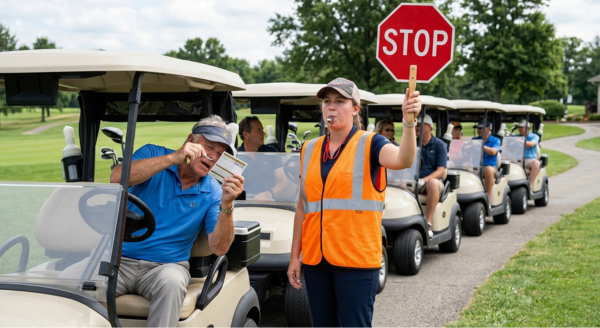
Carts jam up at the first cart path fork, a few groups guess wrong and end up at the wrong hole, and your 10:00am horn slips to 10:12 because hole 14 is still empty. Fix it by staging guides, not just signage, at every cart path decision point, not only at the hole entrances.
A laminated sign is easy to miss when someone is looking for a golf cart, a cooler, and their scorecard all at once. A person waving them in the right direction is not.
Release carts in a staggered sequence rather than all at once, starting with the holes furthest from the clubhouse so they get a head start on the drive. According to CaddieHQ's breakdown of shotgun tournament logistics, an 18-hole course can reasonably handle a field of up to 144 players in a shotgun format.
That capacity only holds up if the course and the traffic flow between holes has actually been planned for it in advance with the pro shop.
Plenty of courses are big enough, hilly enough, or wooded enough that a single horn or siren doesn't reliably reach every hole. Don't find this out the morning of the event.
Confirm with the course whether their system covers every hole, and if there's any doubt, give each hole captain a synchronized watch, a text alert, or a radio cue as backup. A shotgun start where half the course begins a full minute after the other half isn't a shotgun start anymore, it's just a very confusing tee-time start with extra steps.
Get these four pieces right: hole assignments, a disciplined welcome speech, a managed parade to the holes, and a horn everyone actually hears. Do that, and the format does exactly what it's supposed to: get 100-plus golfers playing, finishing, and celebrating together, on one clock, for one cause.