
.svg)
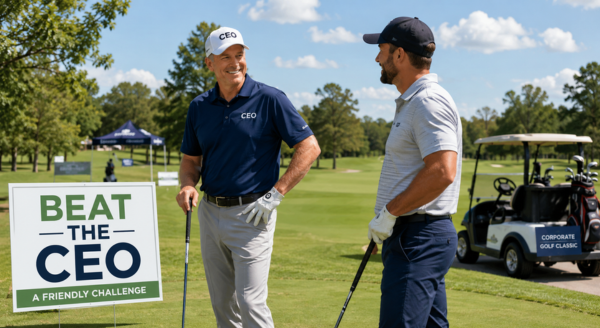
The classic setup is simple: pay $20, hit a shot on a par-3, and try to land it closer to the pin than the pro standing next to you. If you beat them, you win a prize or get your money back. If you don't, the money goes to charity. The whole thing takes about 90 seconds and it's consistently one of the most-talked-about holes on any outing.
You don't need a PGA Tour player. A local club pro, a teaching professional, or a legitimate scratch golfer does the job. What you need is someone who can consistently hit a par-3 green and make players feel the competition is real — because it is.
Equipment requirements are minimal: a laser rangefinder or tape measure to settle disputes, and one volunteer to manage the line, collect the fee, and track the results. That's it. The pro either volunteers or is compensated modestly, and when they do volunteer, this game costs you almost nothing to run.
Charge $5 and golfers treat it like a novelty. Charge $20 and suddenly they're talking about it on the walk from the 9th green to the 10th tee. The $15–$25 range is the sweet spot — high enough to create stakes, low enough that most players will try it twice if they lose.
A second option worth adding: charge $10 to buy a tip from the pro before your shot. Some players aren't confident enough to bet but they'll pay for advice. This captures engagement from golfers who would otherwise walk past without participating.
"Beat the CEO" is the same game with a completely different social layer. Now it's not about winning a prize — it's about beating the boss, the board chair, or whoever the organization has stationed at the hole. Pride is a stronger motivator than a gift card, and every golfer who steps up to that tee box is doing so with something to prove.
The same logic applies to "Beat the Local Celebrity." The celebrity doesn't need to actually be famous — a beloved local figure, a respected community leader, or a longtime board member works fine. What matters is that players know who they are and have some emotional reason to care about the outcome. A local weatherman or a high school coach most participants grew up watching will outperform a regional figure nobody recognizes.
"Beat the College Athlete" hits differently for university-affiliated charities and school fundraisers. A current or former college golfer at the par-3 gives donors a connection to the cause and a genuine athletic challenge.
Most hole sponsorships get a sign in the ground. Beat the Pro gives a sponsor something different: their brand attached to a moment players remember when they're recapping the round at dinner.
The hole sponsor owns the entire experience — their logo on the signage, their name on the contest, their brand associated with competition and a specific memory. "The XYZ Company Beat the Pro Challenge" is a fundamentally different pitch than "we'll put your logo on a tee sign at hole 7." One is a placement. The other is an experience.
When you're selling sponsorships, that difference in framing changes the conversation. According to OneCause's guide on charity event golf sponsorships, hole gamification like this dramatically increases sponsorship appeal because it gives sponsors genuine brand activation, not just visibility. Sponsors pay more for association with something happening than they pay for a sign.
Not telling golfers about this at the first tee. If you don't announce it during the shotgun start, you'll have entire carts drive past hole 7 before realizing what's happening. By then, the moment is gone and the line has already formed without them.
Announce it at registration. Mention it at the opening. Put it in whatever materials players get at the start. The game only works if everyone knows it's coming.
One volunteer at the hole can manage everything: collect fees, hand out scorecards, measure distances, and hand out prizes. Keep the line moving — if a group takes too long, you'll create a backup that throws off the pace of play for the rest of the field.
Have prizes stocked at the hole, not back at the clubhouse. If someone beats the pro and has to wait until dinner to collect their prize, the moment deflates completely. The payoff should be immediate.
The best version of this game is the one where players are still talking about it at the 18th hole. That happens when the fee is right, the competition feels real, and the result is immediate — win or lose, you know exactly where you stand before you walk off the green.
Whether it's a PGA-caliber local pro or the organization's CEO holding a 7-iron, the game works because it creates a personal competition inside a casual group round. Golf outings are full of moments where players are passively moving through the course. This is one of the few stops where something is actually at stake.