
.svg)
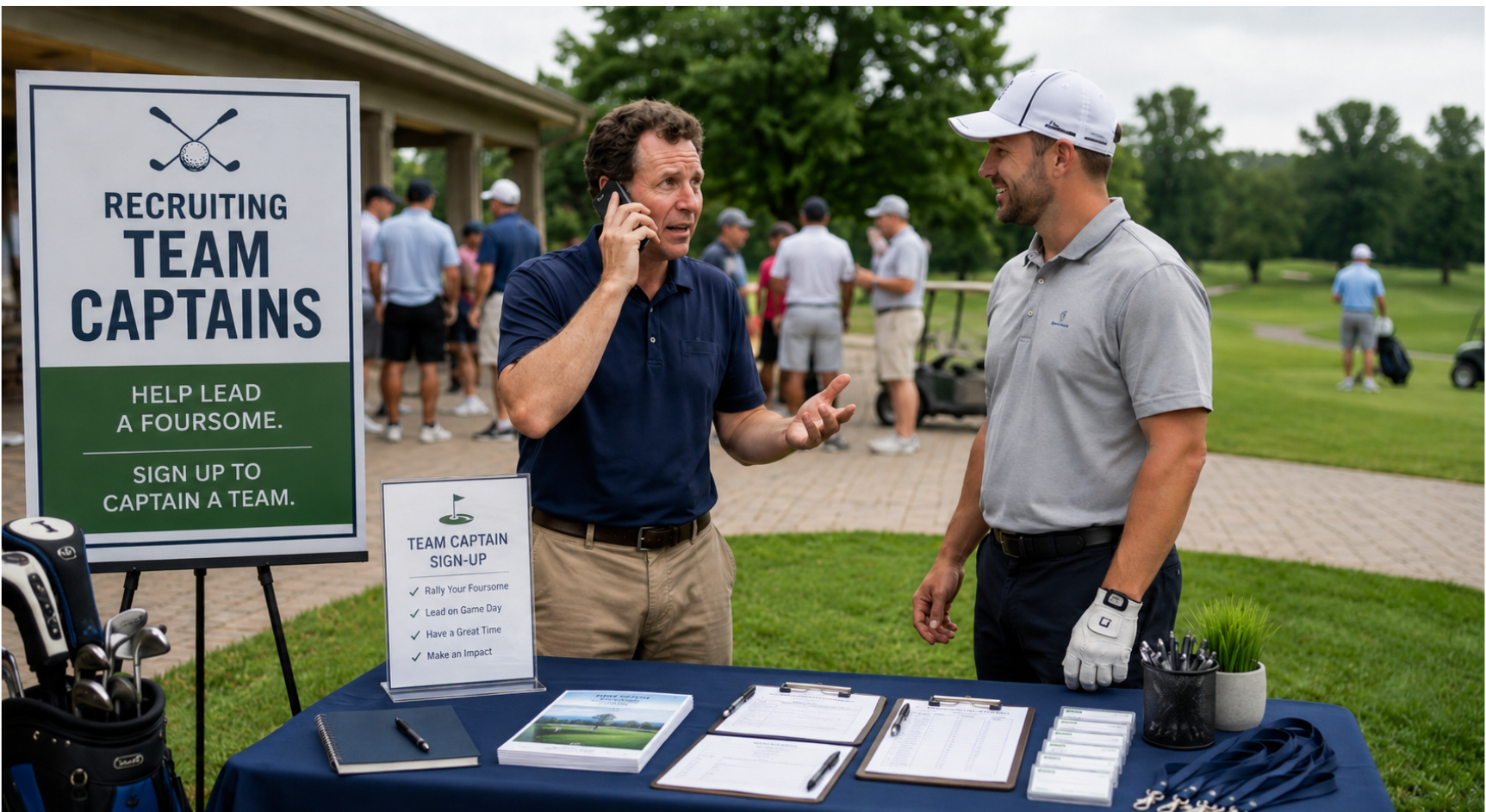
Most charity golf outings don't have a recruitment problem. They have a math problem. If you're trying to fill 144 spots (2 foursomes on each hole), and you're asking every committee member to "spread the word," you've already lost. Nobody spreads the word. What they do is forward an email and move on.
You don't need 144 golfers. You need 36 team captains.
Each captain's job is exactly this: get three other people to show up and play golf with them. That's a conversation that happens over text, at a networking event, or at a family dinner. It's not a fundraising ask, it's "hey, I need a fourth." That question converts at a dramatically higher rate than any email campaign you've ever sent.
When you restructure recruitment this way, you're distributing the work to the people best positioned to do it, and you're making the ask smaller for everyone involved.
The best team captains know people you can't reach. They pick up the phone instead of sending emails, and when they call, those people answer. A committee member with 30 genuine relationships in the local golf community is worth more than an organization with 3,000 email subscribers who have learned to ignore you.
Look at your board first. Then look at your major sponsors. Then look at anyone who's played in your outing two or more times. Those are your captain candidates.
Sponsors already have a financial stake in the event. Asking them to fill their own foursome as part of the sponsorship package is a natural extension of that relationship and it gives the sponsorship a built-in deliverable beyond logo placement.
When you pitch a hole sponsorship or a presenting sponsorship, include "team registration for a foursome" as a line item. Now you've sold the sponsorship and secured four players in the same conversation. For a mid-size outing, a handful of these packages can fill 20–30% of your field before general recruitment even begins.
Recruiting team captains without giving them what they need to follow through is where most outings lose the model. Hand each captain a direct registration link, a short email or text template they can copy and paste, and a save-the-date graphic sized for a phone screen. Remove every possible point of friction.
Set a soft captain deadline two to three weeks before general registration closes. Something like: "Captains have priority on hole assignments and team placement, but only if your foursome is confirmed by [date]." This creates urgency without pressure, and it filters out captains who are enthusiastic in March but vague by May.
The reason most events struggle to fill their field is that organizers treat recruitment like marketing. They post on social media, send newsletters, and update the event website. None of that is recruitment, it's visibility with the option to ignore or push off till later. Visibility doesn't fill foursomes. Direct communication and pressure on team captains fills outings.
Actual recruitment is a board member texting someone on a Tuesday afternoon: "I'm putting together a foursome for our golf outing in June. You in?" That text converts. The monthly email newsletter usually doesn't.
The team captain model works because it multiplies those personal asks across 36 people who are all calling their own networks at the same time. You're not doing the recruiting, you're organizing the people who are.
For 36 teams, you realistically need 40–45 captains in your pipeline. Some won't deliver. Life happens, schedules conflict, and a few captains will come back in week six saying their foursome fell through. That's normal. Build the buffer in from the start so attrition doesn't leave you scrambling.
Keep a waiting list of captains you couldn't initially accommodate. If your first wave doesn't close their foursomes, you have a second tier ready to step in.
Once you have one captain, suggest that they should try to recruit another captain or two out of their own friend group. Friends like to play together, so make sure they know the option is available.