
.svg)
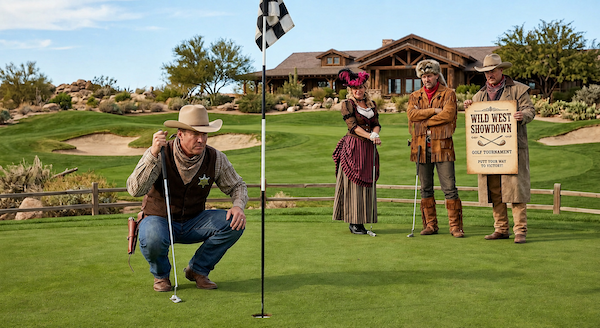
Most charity golf outings are forgettable. Golfers show up, hit balls, eat chicken, go home. Adding a theme is the single fastest way to make yours the one people actually talk about — and the one sponsors want back on.
A theme isn't decoration. It's a framework that organizes every decision you make.
When you run a "Wild West Shootout," the first hole becomes "The Outlaw's Draw," the lunch sponsor becomes "The Saloon," and the best-dressed prize goes to whoever shows up in the most ridiculous cowboy boots. Everything coheres.
Sponsors aren't buying a generic hole sign — they're buying a branded character in a story. That distinction matters financially. Sponsors who feel like they're part of a concept are more likely to return year after year, and more willing to pay a premium for the naming rights that come with it.
The best themes pull from one of three wells: nostalgia, local identity, or pop culture.
"The 80s Scramble," "The [City Name] Legends Classic," or a theme tied to a current TV show or movie all give golfers something to immediately grab onto and run with. Avoid themes that are too abstract or too broad. "A Night of Champions" sounds impressive on paper. "Decades of Fun" means nothing to anyone.
The test: can a golfer in your field immediately picture what to wear? If not, the theme isn't specific enough.
Another angle is to make the theme relevant to the cause your raising funds for. For example, a high school fundraiser theme could be to dress like you did in high school.
Here's where most organizers drop the ball. They pick a theme, print a banner, and call it done.
The theme has to run through every touchpoint or it reads as an afterthought. Work through the event top to bottom:
Generic tournaments sell hole sponsorships. Themed tournaments sell characters.
Nonprofit Tech for Good's guide on creative sponsorships points out that sponsors increasingly want experiential activation, not just a sign in the ground. A theme gives you the scaffolding to offer that.
A sponsor who "owns" the whiskey tasting hole in a Western theme doesn't just get their logo on a placard. They get a story: their rep stands at the hole pouring samples, their brand is woven into every photo taken there, and golfers associate the best moment of their round with that company. That's a renewable sponsorship relationship.
The single most common execution failure: choosing the theme too late.
Golfers need at least six to eight weeks of lead time to plan an outfit, recruit friends around the concept, and build anticipation. Sponsors need the same window to activate meaningfully, not just drop off a banner the morning of. Lock the theme at the same time you lock the date. Build it into your first save-the-date.
The best charity golf themes become annual traditions.
The "Decades Scramble" becomes the one where everyone competes to out-dress each other. The "Wild West Showdown" becomes the one with the whiskey hole. Golfers start planning outfits in February. Sponsors start calling in January. That level of event loyalty is hard to buy. A consistently executed theme is one of the few organic ways to get there.
All the above said, please don't go crazy with your theme and how crazy you get with enforcement. The majority of people don't like dressing up or flat out won't. If getting dressed up feels like a requirement to play in your outing, you're going to severely limit the number of golfers who are willing to play. Have fun with it. Encourage it. But don't punish or call out anyone who doesn't.