
.svg)
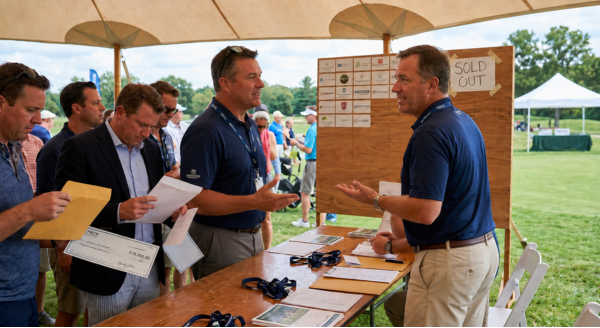
Most charity golf outings treat sponsorship like a yard sale — the more stuff you put out, the better. Eighteen hole sponsors at $100 each. A presenting sponsor. A lunch sponsor. A cart sponsor. A napkin sponsor. By the end, you've got forty businesses slapped onto a tournament that nobody can remember distinctly, and every single one of them wonders if their $100 was worth it.
It wasn't.
Donors give money. Sponsors buy exposure. When you flood an event with sponsors, each one's exposure gets diluted. Your hole sponsor's sign is one of eighteen. Their logo in the program is one of forty. So when the next year rolls around, they're asking, "Did that do anything for us?" And more often than not, they don't come back.
In marketing, repetition and exposure matter more than anything. A logo seen 6 times resonates deeper than 6 logos seen once.
The irony is that more sponsors usually means less money, and often more work year to year. You spend more time collecting logos, chasing checks, printing signs, and managing relationships — all to raise the same amount you could have raised from a handful of well-priced, limited availability partnerships.
Scarcity creates value. A friend of mine who works with content creators to grow their business often recommends limiting sponsors to just a few, but with much higher price tags and exposure. This isn't a marketing theory, it's how every high-end sponsorship program on the planet operates. The Masters doesn't have forty corporate partners. It has a handful of exclusive ones that pay a premium specifically because they're exclusive.
Your charity golf outing isn't the Masters, but the principle holds. When you tell a local business, "We have four hole sponsorships available and two are already committed," three things happen: they take the opportunity more seriously, they are motivated to act sooner, and they're willing to pay more for it.
Businesses that sponsor events aren't doing it because the price is low. They're doing it because it serves a marketing goal and a less crowded sponsorship field makes that goal more achievable.
Here's a simple way to think through the repricing:
Visibility and association, is the primary goal, that's it. The quieter the sponsor noise, the easier it is to deliver both.
When sponsors aren't competing with 30 other logos for attention, their brand stands out. When they're one of six hole sponsors rather than one of eighteen, golfers actually register who they are. When your post-event recap email lists six sponsors instead of forty, each name gets read.
That's the case you make when you pitch the higher price. You're not asking them to pay more for the same thing — you're asking them to pay more for a better thing.
Don't overhaul your entire sponsorship menu before you know this works for your event. Pick one category—preferably your most popular one—and run the experiment.
Cut the available slots by half. Price each remaining slot 30–50% higher. Present it as a limited offering when you pitch it. Track whether the conversations go differently, whether sponsors commit faster, and whether you hit your revenue target with fewer headaches.
Most organizers who try this are surprised to find that sponsors respond better to scarcity than to discounts. The ones who were going to say no to $100 are going to say no to $300 but the ones who were on the fence often tip toward yes when they understand they're getting something exclusive.
Once you've validated the model on one tier, expand it. You'll raise more money, do less work, and give your sponsors something they actually feel good about renewing next year.