
.svg)
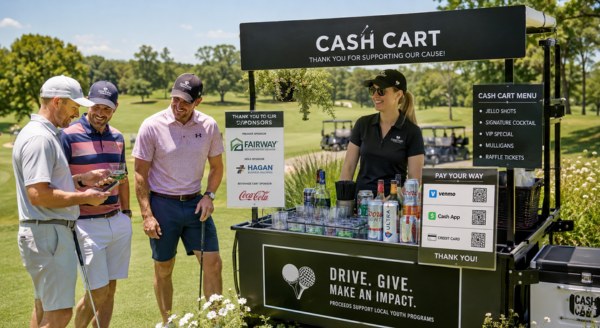
Most charity golf outings have a beverage cart. The smart ones have a cash cart — and they're not the same thing.
A standard beverage cart serves drinks. A cash cart is a mobile revenue engine built around intent: you stock it deliberately, route it strategically, staff it with your best people, and train that person to sell not just refreshments but mulligans, raffle tickets, and premium upgrades. Done right, one cart can add $1,000–$3,000 to your bottom line on top of whatever it earns in drink sales alone.
The inventory is where most organizers undersell themselves. Standard beers and seltzers belong on your regular beverage carts — the cash cart is for high-margin impulse items that feel like a treat.
Start with jello shots at $3–4 each. They're cheap to make, easy to carry, and golfers buy them in rounds, not singles. Add a signature cocktail — a simple, branded drink your committee names after your cause or honoree — at a $7–9 price point. If your course and local laws allow, a premium cigar at $10–15 rounds out the premium tier.
Bundle the cigar and signature cocktail as a "VIP Special" for $18. People who wouldn't buy either item separately will absolutely pull out their phone to Venmo $18 when it sounds like a deal.
Here's the move that separates a good cash cart from a great one: train your volunteer to sell mulligans and raffle tickets mid-round.
Teams that are struggling are your best customers. A group that has already lost three balls and watched their best golfer shank it into the woods is not thinking about the charity — they're thinking about saving face. Walk up with a smile, a jello shot, and the line "Your team needs a fresh start — we've got mulligans, three for $20" and watch what happens.
The reverse is also true: teams playing well don't want mulligans — they want raffle tickets. They're having fun, feeling lucky, riding momentum. "You're playing great — you deserve a shot at the big prize" is not a hard sell to a group that just birdied hole 11.
Brief your cart volunteer to ask every group "how's it going out there?" before pitching anything. The answer tells them exactly what to sell.
A common mistake is sending the cart out at hole one and trusting it to circulate on its own schedule. Route it intentionally.
If your's is a non-shotgun tournament, send the cash cart to holes 4–6 first — by that point teams have loosened up, first drinks are consumed, and the mood is right for impulse buying. Then swing back through holes 13–16 for the "desperation loop" where you move mulligans; teams know exactly how they're doing and how many holes they have left to fix it.
For shotgun events, flag the most challenging holes or holes where golfers have the opportunity to make up strokes (e.g., par 5s and short par 4s). Golfers may be inclined to spend some money to celebrate a win or to keep themselves in contention in case of a mishap.
Cash-only carts leave real money on the course. Most golfers don't carry cash in their pockets during a round, and "I don't have any cash on me" is the most common reason a willing buyer walks away empty-handed.
Tape a Venmo and Cash App QR code to the side of the cart and laminate backup copies in case the originals get wet. If you have cell service and a volunteer willing to manage it, a Square card reader handles the rest. GolfStatus recommends accepting digital payments as a core part of any on-course fundraising strategy — remove the friction and the sales follow.
None of this works with the wrong volunteer behind the wheel. The cash cart requires someone who reads a group quickly, opens with genuine warmth, and can make a pitch feel like a favor rather than a transaction.
You don't need a salesperson — you need someone naturally chatty who can take a joke and won't freeze when a group gives them a hard time. Brief them with two or three opening lines, not a script. Authenticity closes more sales than polish, and a cart volunteer who is genuinely having fun is the best advertisement for whatever they're selling.
Before you spend a dollar stocking the cart, make a few calls. A local liquor store, brewery, or cigar shop will often donate or discount product in exchange for logo placement on the cart — frame it as premium placement, because their brand is on the vehicle that every single team sees multiple times throughout the round.
Mulligan Golf Cards notes that pre-selling mulligans during registration is standard practice — the cash cart model layers an on-course upsell on top of that, capturing a second wave of revenue from teams whose situation has changed after nine holes. You move product before the round and again once it's already in motion.
A cash cart isn't complicated. It's a designated vehicle, stocked with high-margin items, staffed by someone who can sell, routed to find golfers when they're most likely to buy, and set up to accept payment however a player wants to give it.
That's a real upgrade from a standard beverage cart — and the organizers who try it rarely go back.